
Search TAIHUA Products
Learn how to plan a wholesale watch winder order, select SKUs, estimate landed costs, inspect samples, and manage inventory for retail sales.
Category:Wholesale Buying & Sourcing
Author:TAIHUA Admin
Date:2026-11-07
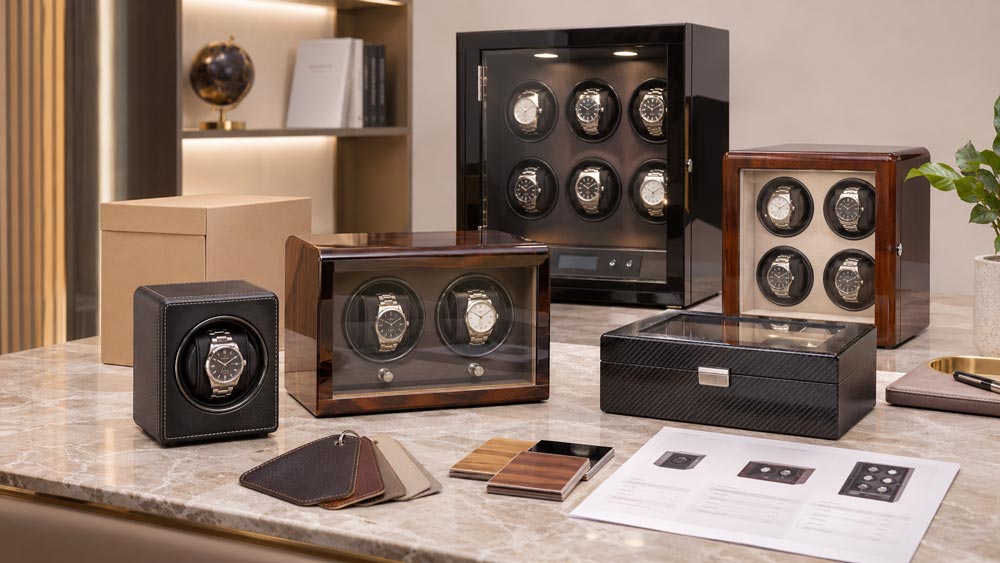
A first wholesale watch winder order should begin with a focused product selection, clear specifications, a realistic purchasing budget, and a plan for inventory replenishment. Retailers should compare total landed costs, approve physical samples, and allocate quantities according to their target customers rather than simply choosing the lowest unit price.
A wholesale watch winder order plan is a purchasing framework that defines which watch winders to buy, how many units to order, what specifications to require, and how the products will be prepared for retail sales.
For watch retailers, accessory brands, and distributors, an effective plan connects product selection with inventory management and future purchasing decisions.
It should answer six questions:
Which watch winder configurations match the target customers?
How many different products should the first order contain?
How should purchasing quantities be distributed?
What is the total landed cost of each product?
Which product specifications and quality requirements need approval?
When should the next order be placed?
The purpose is to reduce purchasing uncertainty and establish a repeatable wholesale buying process.
A useful principle is that the first order should generate meaningful sales information, not simply maximize the number of products offered.
A first wholesale watch winder order can begin with three complementary product configurations: single, double, and four-watch winders.
This is a practical starting framework rather than a universal industry requirement.
Each configuration addresses a different customer need.
| Watch Winder Type | Retail Positioning | Primary Customer Need |
|---|---|---|
| Single Watch Winder | Entry-level collection | Winding one automatic watch |
| Double Watch Winder | Core Retail Collection | Managing two automatic watches |
| 4-Watch Winder | Expanded collection | Winding multiple automatic watches |
The advantage of this structure is product differentiation.
A retailer can compare customer interest in compact products, everyday multi-watch products, and higher-capacity configurations.
Consider two purchasing strategies.
Strategy A: Five Similar Products
A retailer purchases five single-watch winders with different exterior finishes but similar functions and dimensions.
Although the products look different, they largely serve the same customer requirement.
Strategy B: Three Complementary Products
A retailer selects one single-watch winder, one double-watch winder, and one four-watch winder.
The collection covers three distinct customer requirements.
Strategy B provides clearer product positioning and more useful information about demand for different capacities.
This distinction is especially important when a retailer has limited historical sales data.
Premium watch winders can be included when the target market supports higher-value accessories.
Features such as touchscreen controls, integrated storage, decorative finishes, and security functions can help distinguish premium models.
However, premium products should be selected based on the intended customer group rather than included simply because they have more features.
A balanced collection should make the differences between products easy for customers to understand.
Initial order quantity should be determined by the purchasing budget, product mix, expected demand, and supplier requirements.
A useful starting point is to allocate more inventory to the main retail product and smaller quantities to products intended for market testing.
The following example illustrates how a retailer could distribute a hypothetical 120-unit order across three products.
| Product | Quantity | Share of Order | Purchasing Purpose |
|---|---|---|---|
| Single Watch Winder | 36 | 30% | Entry-level demand |
| Double Watch Winder | 60 | 50% | Main retail product |
| 4-Watch Winder | 24 | 20% | Higher-capacity demand |
| Total | 120 | 100% | Three-product collection |
This allocation assumes that the double-watch winder is the retailer's primary product.
It is an illustrative inventory model, not a confirmed TAIHUA MOQ or a measured industry sales distribution.
The retailer can monitor sales performance separately for each product.
Suppose the following quantities sell during an initial evaluation period:
| Product | Initial Quantity | Units Sold | Sell-Through Rate |
|---|---|---|---|
| Single Watch Winder | 36 | 18 | 50% |
| Double Watch Winder | 60 | 42 | 70% |
| 4-Watch Winder | 24 | 8 | 33.3% |
Sell-through rate is calculated as:
Sell-Through Rate = Units Sold ÷ Units Available for Sale × 100
In this example, the double-watch winder performs best during the evaluation period.
The retailer can use this information to adjust future purchasing quantities.
However, sales performance should also be evaluated against selling price, marketing exposure, stock availability, and profit margin.
A higher sell-through rate does not automatically mean a product generates the highest profit.
Product specifications should be confirmed before comparing wholesale quotations.
Two watch winders with similar appearances may have different winding programs, motor configurations, dimensions, and control systems.
A useful purchasing specification sheet should include the following information.
| Specification | What Buyers Should Confirm |
|---|---|
| Winding Capacity | Number of active winding positions |
| Motor Configuration | Motor type and number of motors |
| TPD Settings | Available turns-per-day programs |
| Rotation Direction | Clockwise, counterclockwise, or bidirectional |
| Control System | Buttons, digital display, touchscreen, or other controls |
| Exterior Materials | MDF, wood-grain finish, PU leather, glass, or metal components |
| Watch Cushions | Fit and adjustment for intended watch sizes |
| Power Supply | Voltage, adapter, and plug specifications |
| Product Dimensions | Length, width, and height |
| Product Weight | Net weight and packaged gross weight |
Some watch winders combine automatic winding positions with additional storage compartments.
For example, a product described as having two winding positions and four storage spaces does not wind six watches simultaneously.
It winds two watches while providing separate storage for four additional watches.
Buyers should confirm both numbers independently.
This distinction is important for product naming, retail descriptions, packaging, and customer expectations.
TPD means turns per day. It describes the number of rotations delivered by a watch winder during a programmed operating period.
Automatic watch movements can have different winding requirements.
A watch winder with adjustable TPD and rotation direction provides more configuration flexibility than a model with only one fixed program.
However, buyers should verify the available settings and avoid claiming universal compatibility with every automatic watch movement.
Yes. Operating noise is a relevant consideration for watch winders used in bedrooms, offices, or other quiet environments.
During sample evaluation, buyers should listen for irregular vibration, rattling, and changes in operating sound.
Noise should be assessed under comparable conditions, including the same distance, environment, and operating mode.
A numerical noise claim should only be used when supported by an appropriate measurement method.
Wholesale quotations should be compared using identical product requirements and purchasing conditions.
Comparing only the quoted unit price can lead to incorrect conclusions because suppliers may include different accessories, packaging, or customization services.
A quotation comparison should cover:
Product specifications.
Order quantity per model.
Logo and branding requirements.
Retail packaging.
Included power accessories.
Sample charges.
Production lead time.
Shipping terms.
Inspection arrangements.
Spare parts and after-sales conditions.
Consider two hypothetical quotations for the same product.
Supplier A quotes a lower product price but excludes branded packaging and accessories.
Supplier B quotes a higher price that includes the approved retail packaging and required accessories.
The two offers cannot be compared fairly until the excluded costs are added.
Buyers should therefore request an itemized quotation showing what is included and what is charged separately.
This makes it easier to identify differences in the actual purchasing scope.
Landed cost represents the cost of bringing purchased products to the intended destination, including the applicable purchasing and import-related expenses.
It is more useful for retail pricing decisions than the factory unit price alone.
A simplified calculation is:
Landed Cost Per Unit = Product Cost + Packaging Cost + Allocated Freight + Applicable Duties and Import Costs
The following figures are hypothetical cost units used only to demonstrate the calculation.
| Cost Component | Cost Per Unit |
|---|---|
| Watch Winder Product | 42 |
| Retail Packaging | 3 |
| Allocated International Freight | 8 |
| Allocated Duties and Import Charges | 4 |
| Total Landed Cost | 57 |
The calculated landed cost is 57 cost units per product.
If the intended retail selling price is 110 cost units, the preliminary gross margin is:
Gross Margin = (Selling Price − Landed Cost) ÷ Selling Price × 100
(110 − 57) ÷ 110 × 100 = 48.2%
This is an illustrative calculation, not a real watch winder price quotation.
The calculation also excludes other possible expenses such as marketplace fees, advertising, domestic fulfillment, returns, and business overhead.
International purchasing terms affect which transportation and delivery expenses are included in a quotation.
For example, EXW and FOB quotations allocate different responsibilities between buyer and seller.
The named place, selected Incoterms rule, and agreed shipment conditions should be confirmed before comparing offers.
Buyers should not assume that an international freight quotation includes customs duties, import taxes, or final local delivery unless those services are explicitly stated.
Physical samples should be evaluated before committing to a wholesale order.
A product image can demonstrate appearance, but it cannot fully confirm motor operation, control response, assembly quality, or packaging protection.
A practical sample evaluation should include five areas.
Check surface finishes, panel alignment, edges, decorative components, and visible assembly details.
Wood-grain finishes, PU leather surfaces, and coated panels should be examined for visible defects.
Run the product through its available winding programs.
Confirm rotation direction, program changes, stopping behavior, and rest intervals according to the supplied instructions.
Place suitable test watches or equivalent fit references into the winding positions.
Check whether the cushions hold them securely without excessive pressure or movement.
Test all functions included in the selected model.
For a touchscreen product, confirm that the controls respond correctly.
For a model with a fingerprint lock or remote control, verify the corresponding functions and included accessories.
Inspect the retail box, protective inserts, accessory compartments, and outer shipping carton.
The product should remain properly positioned without loose accessories contacting finished surfaces.
A 24-hour operating observation can be used as an initial functional check because it allows the buyer to observe winding and rest cycles across a full day.
However, a 24-hour observation does not establish long-term motor durability or replace formal reliability testing.
Buyers should agree on appropriate inspection and testing requirements according to the product configuration and purchasing risk.