
Search TAIHUA Products
Learn what affects wholesale watch winder prices, from motors and materials to MOQ, branding, packaging and landed costs. Compare suppliers accurately.
Category:Wholesale Buying & Sourcing
Author:TAIHUA Admin
Date:2026-11-13
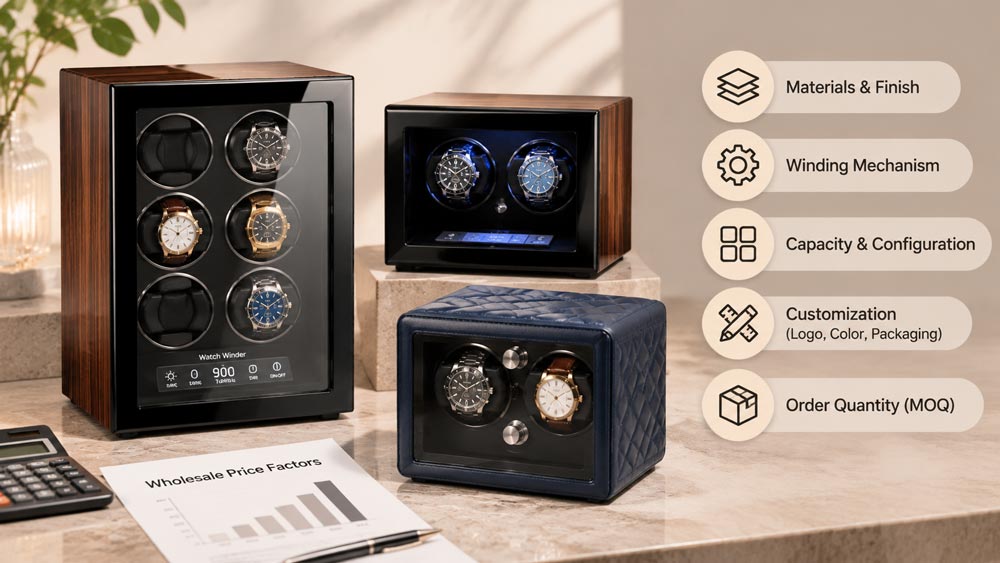
wholesale watch winder prices depend on winding capacity, motor configuration, housing materials, electronic features, order quantity, private label customization, and packaging. International freight and import costs also affect the final purchasing budget. Buyers should compare equivalent specifications and landed costs rather than factory unit prices alone.
A wholesale watch winder price is the supplier's quoted cost for a specified product under agreed purchasing conditions. It may include the product, standard accessories, and packaging, but additional services or transportation costs can be quoted separately.
The most important distinction is between the quoted unit price and the total cost of preparing the product for retail sale.
A complete cost evaluation should examine eight factors:
| Price Factor | Main Cost Driver | What Buyers Should Confirm |
|---|---|---|
| Winding Capacity | Active winding positions and housing size | Number of watches wound simultaneously |
| Motor Configuration | Motor specification and drive arrangement | Motor type and operating programs |
| Exterior Materials | Housing, finishing, and interior lining | Actual materials and surface treatment |
| Electronic Features | Touchscreen, lighting, and locking systems | Features included in the selected model |
| Order Quantity | Quantity per SKU and production arrangements | MOQ and available price breaks |
| Private Label | Logo application and branded components | Setup costs and recurring charges |
| Packaging | Retail boxes and protective inserts | Standard versus customized packaging |
| Logistics | Carton dimensions, freight, and import costs | Applicable shipping terms and destination |
A lower quotation is not necessarily better if essential accessories, packaging, or required features are excluded.
For retailers and distributors, wholesale pricing should be evaluated against the complete product specification and intended selling market.
Winding capacity affects the size, internal construction, and component requirements of a watch winder.
A single-watch winder generally requires a smaller housing than a six-watch or nine-watch model. Higher-capacity products may require larger enclosures, more complex assemblies, and additional packaging protection.
However, capacity alone does not determine the final price.
| Configuration | Main Price Considerations |
|---|---|
| Single Watch Winder | Compact housing, finish, and control system |
| Double Watch Winder | Two winding positions and internal arrangement |
| Triple Watch Winder | Three-position structure and available controls |
| 4-Watch Winder | Larger housing and functional configuration |
| 6-Watch Winder | Multi-position structure, materials, and packaging |
| 9-Watch Winder | High-capacity housing and premium features |
| 2+4 Watch Winder | Two winding positions plus four storage spaces |
A watch winder with two automatic winding positions and four additional storage spaces is not equivalent to a six-watch automatic winder.
The first product actively winds two watches and stores four more. The second actively winds six watches.
TAIHUA's watch winder collection includes both winding-only configurations and models combining winding positions with storage.
This distinction matters when comparing prices because additional storage compartments do not provide the same function as motor-driven winding positions.
A practical comparison should identify the number of active winding positions before calculating cost per winding position.
Motor configuration affects the technical specification and component cost of a watch winder.
Buyers should evaluate motor type, drive arrangement, supported winding programs, and operating characteristics rather than comparing only the number of watch slots.
Important specifications include:
Motor type and configuration.
Available turns-per-day (TPD) settings.
Clockwise, counterclockwise, or bidirectional rotation.
Programmed operating and rest intervals.
Noise and vibration characteristics.
Control system compatibility.
Not necessarily.
Motor quantity can affect component cost, but the relationship depends on the product's complete mechanical and electronic design.
Buyers should not assume that every winding position requires one independent motor or that two products with the same capacity have identical motor arrangements.
For a meaningful price comparison, request the actual motor configuration and winding specifications for each model.
They can.
Adjustable TPD programs provide different winding schedules, while rotation settings help users select an appropriate winding direction for their automatic watches.
A product with multiple selectable programs may use a different control system from a simpler fixed-program model.
The price difference should be assessed together with the actual features, controller, and operating specifications.
Housing materials influence component costs, finishing requirements, product appearance, and packaging protection.
Common watch winder materials include MDF, wood-grain finishes, PU leather, metal components, glass panels, and different interior linings.
| Material or Finish | Main Pricing Consideration |
|---|---|
| MDF Housing | Construction, thickness, and finishing |
| Wood-Grain Surface | Substrate, decorative finish, and workmanship |
| High-Gloss Finish | Coating process and surface quality |
| PU Leather | Material grade, covering, and stitching |
| Metal Components | Material, machining, and surface treatment |
| Glass Panels | Glass specification, dimensions, and assembly |
| Interior Lining | Material selection and fitting requirements |
No.
The final price depends on the complete construction, not just the visible material.
An MDF housing with a decorative wood-grain finish is different from a solid-wood housing. Both may be marketed as wooden-style watch winders, but their material costs and production requirements are different.
Similarly, PU leather products vary in construction, lining, decorative elements, and finishing.
Buyers should confirm the actual substrate, surface material, and finish specifications.
A premium-looking product photograph alone is not sufficient evidence of material quality.
Electronic features can create meaningful price differences between watch winders with similar winding capacities.
The actual impact depends on the selected electronic components, control architecture, product structure, and assembly requirements.
TAIHUA's existing collection includes products with touchscreen controls, fingerprint locking, and LED lighting.
These features are not present in every model.
| Electronic Feature | Product Function | Cost Consideration |
|---|---|---|
| Touchscreen Control | Digital operation and setting selection | Display and control components |
| Fingerprint Lock | Fingerprint-based access control | Sensor and locking assembly |
| LED Lighting | Illuminates the display area | Lighting components and wiring |
| Digital Display | Shows operating information | Display and control integration |
| Remote Control | Remote operation on supported models | Receiver and remote accessories |
Not automatically.
A retailer targeting customers who need a compact, functional watch winder may not require fingerprint access or decorative lighting.
A retailer building a premium collection may consider these functions important for product differentiation.
The purchasing decision should reflect the target customer's requirements and the expected retail price.
A higher-priced model is commercially useful only when its additional features support a clear product position.
Order quantity can influence the allocation of setup expenses, packaging preparation, procurement efficiency, and available price breaks.
However, wholesale prices do not always decrease at a fixed percentage when quantity increases.
Buyers should request quotations for specific quantities instead of assuming a standard discount rate.
Suppose a private label project involves a hypothetical one-time artwork and branding setup charge of $180.
| Order Quantity | Total Setup Charge | Setup Cost Per Unit |
|---|---|---|
| 60 units | $180 | $3.00 |
| 120 units | $180 | $1.50 |
| 300 units | $180 | $0.60 |
The calculation is:
Setup Cost Per Unit = Total Setup Charge ÷ Order Quantity
Increasing the order from 60 to 300 units reduces the allocated setup charge from $3.00 to $0.60 per unit.
These figures illustrate cost allocation; they are not actual TAIHUA charges or minimum order quantities.
No.
A larger purchase may reduce certain per-unit costs while increasing the amount of money committed to inventory.
If a retailer purchases 300 units but sells only 60 during the initial selling period, the remaining 240 units continue to occupy inventory and working capital.
For a new collection, purchasing flexibility and product demand can be more important than maximizing the quantity discount.
private label watch winder pricing depends on the branding method and the additional preparation required.
For many retailers and accessory brands, the most practical approach is to select existing products and customize their brand presentation.
TAIHUA provides private label options involving logos, selected finishes, packaging, and product presentation materials.
Common cost categories include:
| Customization Item | Potential Cost Component |
|---|---|
| Logo Application | Printing, engraving, or nameplate application |
| Exterior Finish | Selected material or color variation |
| Retail Box | Customized printing and box preparation |
| Printed Manual | Artwork and printing |
| Product Label | Branding and product identification |
| Marketing Materials | Photography, video, or product content preparation |
The actual availability and charges depend on the selected model and order arrangement.
No.
Private label usually focuses on branding suitable existing products.
Developing a new housing, motor architecture, or electronic control system involves a different scope of engineering and sourcing work.
These requirements should be quoted separately rather than treated as ordinary logo or packaging customization.
For new brands, existing product configurations can provide a practical starting point without adding unnecessary development costs.
Packaging influences both product presentation and transportation protection.
A standard protective package and a custom-branded retail presentation box may have different material, printing, and preparation costs.
The complete packaging specification may include:
Printed retail box.
Protective internal inserts.
Surface protection.
Adapter compartment.
Product manual and labels.
Outer shipping carton.
Larger watch winders may need additional protective structures because of their housing dimensions, glass panels, and exterior finishes.
Yes.
International express carriers may calculate transportation charges using dimensional weight.
For example, FedEx publishes the following dimensional-weight formula for applicable services:
Dimensional Weight (kg) = Length × Width × Height (cm) ÷ 5,000
Assume a packaged watch winder measures:
Length: 45 cm
Width: 35 cm
Height: 30 cm
Its calculated dimensional weight is:
45 × 35 × 30 ÷ 5,000 = 9.45 kg
If its actual weight is 7 kg, a service using the greater of actual and dimensional weight may calculate charges based on 9.45 kg, subject to applicable rounding and billing rules.
This example demonstrates why packaging dimensions should be reviewed before finalizing international shipping arrangements.
Source: FedEx Dimensional Weight Calculation.
Previous:
Next: What Is the Minimum Order Quantity for Wholesale Watch Winders?